Wave Surfing Introduction
Origins
Wave Surfing was invented by ABC (author of Shadow) in the early 2000s and represents one of the most significant innovations in competitive Robocode. Before Wave Surfing, movement strategies were mostly Random or Oscillating, bots would move erratically hoping to avoid bullets by chance. ABC's discovery changed the game from a test of luck to a test of statistical prediction, revolutionizing defensive movement by transforming bullet dodging from reactive guesswork into predictive statistical analysis.
Wave Surfing is more than just "dodging bullets", it's the defensive counterpart to GuessFactor Targeting. While GuessFactor guns track where enemies dodge to, Wave Surfing tracks where enemies shoot and move to locations they're least likely to target.
This technique enables bots to achieve hit rates below 10% against strong statistical guns, a dramatic improvement over traditional evasion methods like random movement or oscillators, which typically get hit 20-40% of the time.
The Core Insight
Traditional movement asks: "Where should I go to be unpredictable?"
Wave Surfing asks: "Where will the enemy think I'm going, and how can I avoid being there?"
The key realization: if your enemy uses statistical targeting (GuessFactor, Dynamic Clustering, etc.), they're predicting your movement based on your past behavior. By tracking their statistics and intentionally moving to locations they historically don't shoot at, you can minimize your hit rate.
How Wave Surfing Works
1. Detect Enemy Fire
When the enemy's energy drops by 0.1 to 3.0, they've fired a bullet:
Pass the previous and current enemy energy to detectFire(...). A drop from 0.1 through 3.0 is treated as a possible shot, so collision and melee-specific filters should be added when the surrounding bot has that information.
2. Create an Enemy Wave
Model the bullet as an expanding circle (wave) centered at the enemy's fire position:
Store the enemy's position at the estimated fire turn, the bullet speed 20 - 3 × bulletPower, and the direct angle from the enemy to the bot. The wave's radius on turn t is bulletSpeed × (t - fireTime).

Enemy wave expanding from fire position toward the surfing bot
3. Record Danger When Hit
When a wave hits you (or passes by), record which GuessFactor you were at when the wave was fired:
Call recordPass(...) with the bot's position and lateral velocity. It normalizes the angle offset by the maximum escape angle asin(8 / bulletSpeed), then increments that GuessFactor's danger bin.
Over many battles, you build a danger profile showing which GuessFactors the enemy prefers.
4. Predict Wave Intersection
As the wave approaches, calculate where it will intersect your bot:
Call willHitSoon(...) when the wave front is within 18 units of the bot. The 18-unit margin approximates the bot's radius and gives the movement controller time to choose a destination.
5. Move to Safest GuessFactor
Before the wave hits, move perpendicular to the enemy to change your GuessFactor to the safest available location:
Ask safestGuessFactor() for the least dangerous recorded bin, then call positionAtGuessFactor(...) to get a point on that escape arc. A real controller must still check whether the point is reachable before sending movement commands.
The following API-neutral model implements these core calculations. It uses mathematical angles in radians; a platform adapter converts headings and turn commands as needed.
import java.util.HashMap;
import java.util.Map;

public final class WaveSurfingModel {
    private static final int BIN_COUNT = 31;
    private static final double MIN_POWER = 0.1;
    private static final double MAX_POWER = 3.0;
    private static final double BOT_RADIUS = 18.0;
    private final Map<String, Double> previousEnergy = new HashMap<>();
    private final int[] danger = new int[BIN_COUNT];

    public Wave detectFire(
            String enemyId, double enemyEnergy, double enemyX, double enemyY,
            double myX, double myY, double lateralVelocity, long turn) {
        Double oldEnergy = previousEnergy.put(enemyId, enemyEnergy);
        if (oldEnergy == null) {
            return null;
        }
        double power = oldEnergy - enemyEnergy;
        if (power < MIN_POWER || power > MAX_POWER) {
            return null;
        }

        double directAngle = Math.atan2(myY - enemyY, myX - enemyX);
        return new Wave(enemyX, enemyY, turn, 20 - 3 * power,
                directAngle, lateralVelocity >= 0 ? 1 : -1);
    }

    public void recordPass(Wave wave, double myX, double myY) {
        double angle = Math.atan2(myY - wave.originY, myX - wave.originX);
        double offset = normalizeRelativeAngle(angle - wave.directAngle);
        double escapeAngle = Math.asin(8.0 / wave.bulletSpeed);
        double guessFactor = clamp(offset / escapeAngle * wave.lateralDirection, -1, 1);
        danger[guessFactorToBin(guessFactor)]++;
    }

    public boolean willHitSoon(Wave wave, long turn, double myX, double myY) {
        double radius = wave.bulletSpeed * (turn - wave.fireTurn);
        return radius >= Math.hypot(myX - wave.originX, myY - wave.originY) - BOT_RADIUS;
    }

    public double safestGuessFactor() {
        int bestBin = BIN_COUNT / 2;
        int bestDanger = score(bestBin);
        for (int bin = 1; bin < BIN_COUNT - 1; bin++) {
            int score = score(bin);
            if (score < bestDanger) {
                bestDanger = score;
                bestBin = bin;
            }
        }
        return binToGuessFactor(bestBin);
    }

    public Point positionAtGuessFactor(Wave wave, double guessFactor, double distance) {
        double escapeAngle = Math.asin(8.0 / wave.bulletSpeed);
        double angle = wave.directAngle + guessFactor * escapeAngle * wave.lateralDirection;
        return new Point(wave.originX + distance * Math.cos(angle), wave.originY + distance * Math.sin(angle));
    }

    private int score(int center) {
        return danger[center - 1] + danger[center] + danger[center + 1];
    }

    private static int guessFactorToBin(double value) {
        int bin = (int) Math.round((clamp(value, -1, 1) + 1) * 0.5 * (BIN_COUNT - 1));
        return Math.max(0, Math.min(BIN_COUNT - 1, bin));
    }

    private static double binToGuessFactor(int bin) {
        return bin * 2.0 / (BIN_COUNT - 1) - 1.0;
    }

    private static double normalizeRelativeAngle(double angle) {
        while (angle <= -Math.PI) angle += 2 * Math.PI;
        while (angle > Math.PI) angle -= 2 * Math.PI;
        return angle;
    }

    private static double clamp(double value, double minimum, double maximum) {
        return Math.max(minimum, Math.min(maximum, value));
    }

    public static final class Wave {
        final double originX;
        final double originY;
        final long fireTurn;
        final double bulletSpeed;
        final double directAngle;
        final int lateralDirection;

        Wave(double originX, double originY, long fireTurn, double bulletSpeed,
                double directAngle, int lateralDirection) {
            this.originX = originX;
            this.originY = originY;
            this.fireTurn = fireTurn;
            this.bulletSpeed = bulletSpeed;
            this.directAngle = directAngle;
            this.lateralDirection = lateralDirection;
        }
    }

    public static final class Point {
        public final double x;
        public final double y;

        Point(double x, double y) {
            this.x = x;
            this.y = y;
        }
    }
}from dataclasses import dataclass
from math import asin, atan2, cos, hypot, pi, sin
BIN_COUNT = 31
BOT_RADIUS = 18.0
@dataclass
class Wave:
origin_x: float
origin_y: float
fire_turn: int
bullet_speed: float
direct_angle: float
lateral_direction: int
@dataclass
class Point:
x: float
y: float
class WaveSurfingModel:
def __init__(self) -> None:
self.previous_energy: dict[str, float] = {}
self.danger = [0] * BIN_COUNT
def detect_fire(
self,
enemy_id: str,
enemy_energy: float,
enemy_x: float,
enemy_y: float,
my_x: float,
my_y: float,
lateral_velocity: float,
turn: int,
) -> Wave | None:
old_energy = self.previous_energy.get(enemy_id)
self.previous_energy[enemy_id] = enemy_energy
if old_energy is None:
return None
power = old_energy - enemy_energy
if not 0.1 <= power <= 3.0:
return None
direct_angle = atan2(my_y - enemy_y, my_x - enemy_x)
return Wave(enemy_x, enemy_y, turn, 20 - 3 * power, direct_angle,
1 if lateral_velocity >= 0 else -1)
def record_pass(self, wave: Wave, my_x: float, my_y: float) -> None:
angle = atan2(my_y - wave.origin_y, my_x - wave.origin_x)
offset = normalize_relative_angle(angle - wave.direct_angle)
escape_angle = asin(8 / wave.bullet_speed)
guess_factor = clamp(offset / escape_angle * wave.lateral_direction, -1, 1)
self.danger[guess_factor_to_bin(guess_factor)] += 1
def will_hit_soon(self, wave: Wave, turn: int, my_x: float, my_y: float) -> bool:
radius = wave.bullet_speed * (turn - wave.fire_turn)
return radius >= hypot(my_x - wave.origin_x, my_y - wave.origin_y) - BOT_RADIUS
def safest_guess_factor(self) -> float:
best_bin = BIN_COUNT // 2
best_danger = self.score(best_bin)
for center in range(1, BIN_COUNT - 1):
score = self.score(center)
if score < best_danger:
best_danger = score
best_bin = center
return bin_to_guess_factor(best_bin)
def position_at_guess_factor(self, wave: Wave, guess_factor: float, distance: float) -> Point:
escape_angle = asin(8 / wave.bullet_speed)
angle = wave.direct_angle + guess_factor * escape_angle * wave.lateral_direction
return Point(wave.origin_x + distance * cos(angle), wave.origin_y + distance * sin(angle))
def score(self, center: int) -> int:
return self.danger[center - 1] + self.danger[center] + self.danger[center + 1]
def guess_factor_to_bin(value: float) -> int:
index = round((clamp(value, -1, 1) + 1) * 0.5 * (BIN_COUNT - 1))
return max(0, min(BIN_COUNT - 1, index))
def bin_to_guess_factor(index: int) -> float:
return index * 2 / (BIN_COUNT - 1) - 1
def normalize_relative_angle(angle: float) -> float:
while angle <= -pi:
angle += 2 * pi
while angle > pi:
angle -= 2 * pi
return angle
def clamp(value: float, minimum: float, maximum: float) -> float:
return max(minimum, min(maximum, value))import java.util.HashMap;
import java.util.Map;
public final class WaveSurfingModel {
private static final int BIN_COUNT = 31;
private static final double BOT_RADIUS = 18.0;
private final Map<String, Double> previousEnergy = new HashMap<>();
private final int[] danger = new int[BIN_COUNT];
public Wave detectFire(
String enemyId, double enemyEnergy, double enemyX, double enemyY,
double myX, double myY, double lateralVelocity, long turn) {
Double oldEnergy = previousEnergy.put(enemyId, enemyEnergy);
if (oldEnergy == null) {
return null;
}
double power = oldEnergy - enemyEnergy;
if (power < 0.1 || power > 3.0) {
return null;
}
double directAngle = Math.atan2(myY - enemyY, myX - enemyX);
return new Wave(enemyX, enemyY, turn, 20 - 3 * power,
directAngle, lateralVelocity >= 0 ? 1 : -1);
}
public void recordPass(Wave wave, double myX, double myY) {
double angle = Math.atan2(myY - wave.originY, myX - wave.originX);
double offset = normalizeRelativeAngle(angle - wave.directAngle);
double escapeAngle = Math.asin(8.0 / wave.bulletSpeed);
double guessFactor = clamp(offset / escapeAngle * wave.lateralDirection, -1, 1);
danger[guessFactorToBin(guessFactor)]++;
}
public boolean willHitSoon(Wave wave, long turn, double myX, double myY) {
double radius = wave.bulletSpeed * (turn - wave.fireTurn);
return radius >= Math.hypot(myX - wave.originX, myY - wave.originY) - BOT_RADIUS;
}
public double safestGuessFactor() {
int bestBin = BIN_COUNT / 2;
int bestDanger = score(bestBin);
for (int bin = 1; bin < BIN_COUNT - 1; bin++) {
int score = score(bin);
if (score < bestDanger) {
bestDanger = score;
bestBin = bin;
}
}
return binToGuessFactor(bestBin);
}
public Point positionAtGuessFactor(Wave wave, double guessFactor, double distance) {
double escapeAngle = Math.asin(8.0 / wave.bulletSpeed);
double angle = wave.directAngle + guessFactor * escapeAngle * wave.lateralDirection;
return new Point(wave.originX + distance * Math.cos(angle), wave.originY + distance * Math.sin(angle));
}
private int score(int center) {
return danger[center - 1] + danger[center] + danger[center + 1];
}
private static int guessFactorToBin(double value) {
int bin = (int) Math.round((clamp(value, -1, 1) + 1) * 0.5 * (BIN_COUNT - 1));
return Math.max(0, Math.min(BIN_COUNT - 1, bin));
}
private static double binToGuessFactor(int bin) {
return bin * 2.0 / (BIN_COUNT - 1) - 1.0;
}
private static double normalizeRelativeAngle(double angle) {
while (angle <= -Math.PI) angle += 2 * Math.PI;
while (angle > Math.PI) angle -= 2 * Math.PI;
return angle;
}
private static double clamp(double value, double minimum, double maximum) {
return Math.max(minimum, Math.min(maximum, value));
}
public static final class Wave {
final double originX;
final double originY;
final long fireTurn;
final double bulletSpeed;
final double directAngle;
final int lateralDirection;
Wave(double originX, double originY, long fireTurn, double bulletSpeed,
double directAngle, int lateralDirection) {
this.originX = originX;
this.originY = originY;
this.fireTurn = fireTurn;
this.bulletSpeed = bulletSpeed;
this.directAngle = directAngle;
this.lateralDirection = lateralDirection;
}
}
public static final class Point {
public final double x;
public final double y;
Point(double x, double y) {
this.x = x;
this.y = y;
}
}
}using System;
using System.Collections.Generic;
public sealed class WaveSurfingModel
{
private const int BinCount = 31;
private const double BotRadius = 18.0;
private readonly Dictionary<string, double> previousEnergy = new();
private readonly int[] danger = new int[BinCount];
public Wave? DetectFire(
string enemyId, double enemyEnergy, double enemyX, double enemyY,
double myX, double myY, double lateralVelocity, long turn)
{
if (!previousEnergy.TryGetValue(enemyId, out double oldEnergy))
{
previousEnergy[enemyId] = enemyEnergy;
return null;
}
previousEnergy[enemyId] = enemyEnergy;
double power = oldEnergy - enemyEnergy;
if (power < 0.1 || power > 3.0)
{
return null;
}
double directAngle = Math.Atan2(myY - enemyY, myX - enemyX);
return new Wave(enemyX, enemyY, turn, 20 - 3 * power,
directAngle, lateralVelocity >= 0 ? 1 : -1);
}
public void RecordPass(Wave wave, double myX, double myY)
{
double angle = Math.Atan2(myY - wave.OriginY, myX - wave.OriginX);
double offset = NormalizeRelativeAngle(angle - wave.DirectAngle);
double escapeAngle = Math.Asin(8.0 / wave.BulletSpeed);
double guessFactor = Clamp(offset / escapeAngle * wave.LateralDirection, -1, 1);
danger[GuessFactorToBin(guessFactor)]++;
}
public bool WillHitSoon(Wave wave, long turn, double myX, double myY)
{
double radius = wave.BulletSpeed * (turn - wave.FireTurn);
return radius >= Math.Sqrt(Math.Pow(myX - wave.OriginX, 2) + Math.Pow(myY - wave.OriginY, 2)) - BotRadius;
}
public double SafestGuessFactor()
{
int bestBin = BinCount / 2;
int bestDanger = Score(bestBin);
for (int bin = 1; bin < BinCount - 1; bin++)
{
int score = Score(bin);
if (score < bestDanger)
{
bestDanger = score;
bestBin = bin;
}
}
return BinToGuessFactor(bestBin);
}
public Point PositionAtGuessFactor(Wave wave, double guessFactor, double distance)
{
double escapeAngle = Math.Asin(8.0 / wave.BulletSpeed);
double angle = wave.DirectAngle + guessFactor * escapeAngle * wave.LateralDirection;
return new Point(wave.OriginX + distance * Math.Cos(angle), wave.OriginY + distance * Math.Sin(angle));
}
private int Score(int center) => danger[center - 1] + danger[center] + danger[center + 1];
private static int GuessFactorToBin(double value)
{
int bin = (int)Math.Round((Clamp(value, -1, 1) + 1) * 0.5 * (BinCount - 1));
return Math.Max(0, Math.Min(BinCount - 1, bin));
}
private static double BinToGuessFactor(int bin) => bin * 2.0 / (BinCount - 1) - 1.0;
private static double NormalizeRelativeAngle(double angle)
{
while (angle <= -Math.PI) angle += 2 * Math.PI;
while (angle > Math.PI) angle -= 2 * Math.PI;
return angle;
}
private static double Clamp(double value, double minimum, double maximum) =>
Math.Max(minimum, Math.Min(maximum, value));
public sealed record Wave(
double OriginX, double OriginY, long FireTurn,
double BulletSpeed, double DirectAngle, int LateralDirection);
public sealed record Point(double X, double Y);
}type Wave = {
originX: number;
originY: number;
fireTurn: number;
bulletSpeed: number;
directAngle: number;
lateralDirection: number;
};
type Point = { x: number; y: number };
class WaveSurfingModel {
private static readonly binCount = 31;
private readonly previousEnergy = new Map<string, number>();
private readonly danger = new Array<number>(WaveSurfingModel.binCount).fill(0);
detectFire(
enemyId: string,
enemyEnergy: number,
enemyX: number,
enemyY: number,
myX: number,
myY: number,
lateralVelocity: number,
turn: number,
): Wave | null {
const oldEnergy = this.previousEnergy.get(enemyId);
this.previousEnergy.set(enemyId, enemyEnergy);
if (oldEnergy === undefined) return null;
const power = oldEnergy - enemyEnergy;
if (power < 0.1 || power > 3) return null;
return {
originX: enemyX,
originY: enemyY,
fireTurn: turn,
bulletSpeed: 20 - 3 * power,
directAngle: Math.atan2(myY - enemyY, myX - enemyX),
lateralDirection: lateralVelocity >= 0 ? 1 : -1,
};
}
recordPass(wave: Wave, myX: number, myY: number) {
const angle = Math.atan2(myY - wave.originY, myX - wave.originX);
const offset = normalizeRelativeAngle(angle - wave.directAngle);
const escapeAngle = Math.asin(8 / wave.bulletSpeed);
const guessFactor = clamp(offset / escapeAngle * wave.lateralDirection, -1, 1);
this.danger[guessFactorToBin(guessFactor)] += 1;
}
willHitSoon(wave: Wave, turn: number, myX: number, myY: number) {
const radius = wave.bulletSpeed * (turn - wave.fireTurn);
return radius >= Math.hypot(myX - wave.originX, myY - wave.originY) - 18;
}
safestGuessFactor() {
let bestBin = Math.floor(WaveSurfingModel.binCount / 2);
let bestDanger = this.score(bestBin);
for (let center = 1; center < WaveSurfingModel.binCount - 1; center += 1) {
const score = this.score(center);
if (score < bestDanger) {
bestDanger = score;
bestBin = center;
}
}
return bestBin * 2 / (WaveSurfingModel.binCount - 1) - 1;
}
positionAtGuessFactor(wave: Wave, guessFactor: number, distance: number): Point {
const escapeAngle = Math.asin(8 / wave.bulletSpeed);
const angle = wave.directAngle + guessFactor * escapeAngle * wave.lateralDirection;
return {
x: wave.originX + distance * Math.cos(angle),
y: wave.originY + distance * Math.sin(angle),
};
}
private score(center: number) {
return this.danger[center - 1] + this.danger[center] + this.danger[center + 1];
}
}
function guessFactorToBin(value: number) {
const index = Math.round((clamp(value, -1, 1) + 1) * 0.5 * 30);
return Math.max(0, Math.min(30, index));
}
function normalizeRelativeAngle(angle: number) {
while (angle <= -Math.PI) angle += 2 * Math.PI;
while (angle > Math.PI) angle -= 2 * Math.PI;
return angle;
}
function clamp(value: number, minimum: number, maximum: number) {
return Math.max(minimum, Math.min(maximum, value));
}Two Approaches: GoTo Surfing vs. True Surfing
GoTo Surfing
Calculate a destination point at the safest GuessFactor and move toward it using standard GoTo movement:
Pros:
- Simpler to implement
- Works with existing movement code
Cons:
- Less precise
- May not reach the intended GuessFactor in time
True Surfing
Calculate precise movement commands (throttle, turn rate) to arrive at the exact GuessFactor at the exact moment the wave hits:
Pros:
- Maximum precision
- Can dodge multiple overlapping waves
Cons:
- Complex trajectory calculation
- Requires iterative simulation
Most competitive bots use True Surfing for optimal performance.
Danger Calculation
The core of Wave Surfing is accurately modeling enemy danger. The simplest approach:
For every wave that passes the bot, calculate the historical GuessFactor and increment its danger bin. The model above uses a three-bin score when choosing the safest location, which makes one isolated observation less influential.
Advanced implementations use segmentation (distance, lateral velocity, wall distance) just like GuessFactor Targeting but in reverse.
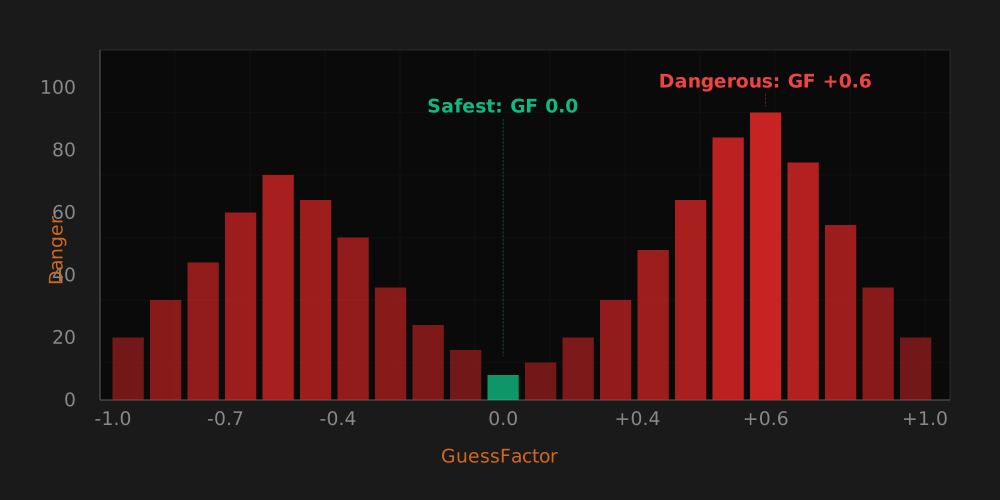
Danger profile showing enemy's firing tendencies across GuessFactors
Wave Management
You'll typically track 2–4 waves simultaneously:
Keep an active list of two to four waves. Append waves returned by detectFire(...), update their radii each turn, and remove a wave after it passes the bot or is confirmed by a bullet-hit event.
Prioritize the closest wave, it will hit first.
Wall Smoothing Integration
Wave Surfing often conflicts with wall avoidance. Solutions:
Approach 1: Calculate danger for all reachable GuessFactors, including wall-smoothed paths.
Approach 2: Use wall smoothing only when no immediate waves threaten, prioritizing wave dodging over wall distance.
Most bots use Approach 1 for better positioning.
Platform Notes
Wave Surfing works identically in classic Robocode and Tank Royale. The only difference is the coordinate system:
- Classic Robocode: heading 0° = north, angles increase clockwise
- Tank Royale: heading 0° = east, angles increase counter-clockwise
The underlying math and wave geometry remain the same, adjust your angle conversions accordingly.
Learning Process
Wave Surfing requires data to work effectively:
First few rounds: High hit rate (30-40%) while gathering statistics.
After 10-20 rounds: Hit rate drops to 15-25% as danger profiles stabilize.
After 35 rounds: Elite surfers achieve < 10% hit rates against strong statistical guns.
Some bots use pre-seeded data from previous battles to improve early-round performance.
Practical Tips
Start with a simple danger: Count hits per GuessFactor. Don't segment until the basics work.
Visualize waves: Draw waves and danger profiles in RobocodeSG/Tank Royale graphics to debug.
Test against known guns: Use GuessFactor sample bots to verify your surfing is detecting and dodging correctly.
Segment cautiously: Over-segmentation causes data sparsity. Start with distance-only segmentation.
Handle bullet hits: When hit, record the GuessFactor where you were struck and increase its danger rating.
Common Mistakes
- Not detecting all bullets: Missing energy drops due to rounding errors or bot death events.
- Wrong GuessFactor calculation: Sign errors in lateral direction or angle offset.
- Ignoring bot rotation: Your bot's turn radius limits which GuessFactors you can reach.
- Over-aggressive dodging: Sometimes "surfing through" danger is better than hitting walls.
- Forgetting data decay: Old data from changed enemy behavior pollutes danger profiles.
When Wave Surfing Fails
Wave Surfing struggles against:
- Random targeting: No pattern to learn from.
- Pattern matchers: They predict future movement, not past behavior.
- Anti-surfer guns: Specifically designed to exploit Wave Surfing assumptions.
Even against these, Wave Surfing is rarely worse than traditional movement, it just doesn't dominate.
Next Steps
Once you have basic Wave Surfing working:
- Wave Surfing Implementations: Compare GoTo vs. True Surfing approaches
- Flattener: Counter enemies who learn your surfing patterns
- Segmentation & Visit Count Stats: Apply segmentation to danger calculation
Further Reading
- Wave Surfing - RoboWiki (classic Robocode)
- Wave Surfing/GoTo Surfing - RoboWiki (classic Robocode)
- Wave Surfing/True Surfing - RoboWiki (classic Robocode)
- Waves - RoboWiki (classic Robocode)
- GuessFactor Targeting - The offensive counterpart