Advanced Statistical Methods
Origins
Symbolic Dynamic Segmentation, the decision-tree approach to bucket boundaries, was developed by Vic Stewart as an improvement on the earlier Zoom Targeting concept, and refined by the RoboWiki community.
Fixed segmentation forces a choice before the first shot: how many distance bands, how many velocity bins, which axes matter. Six distance bands times nine lateral-velocity bins times nine advancing-velocity bins already gives 6 × 9 × 9 = 486 cells in the grid, most of them empty for the first several rounds. A tree that grows its own boundaries sidesteps the guess. It starts as one bucket for the whole enemy and splits only where enough recorded waves justify a finer cut.
A leaf that earns its split
Each leaf in the tree starts as a single GuessFactor histogram, exactly like the segments from Segmentation & Visit Count Stats. Every wave that lands in a leaf adds one observation, and the leaf checks its sample count. Vic Stewart's original implementation waits for 40 observations before a leaf becomes eligible to split, and settled leaves average close to 30 observations once the tree stabilizes.
When a leaf crosses that threshold, the tree tests every candidate axis, such as lateral velocity, distance, or wall proximity, and keeps whichever split separates the recorded GuessFactors most cleanly. The leaf becomes a splitter node with two smaller leaves beneath it, and later waves route to whichever child matches their state.
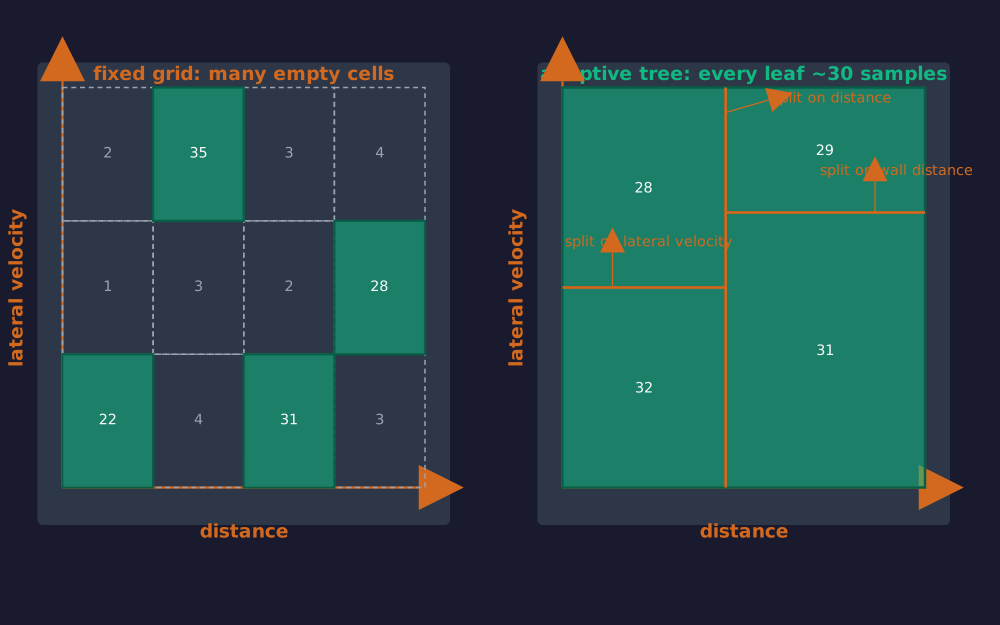
A segmentation tree splits only where wave data supports it, leaving a few well-stocked leaves instead of many nearly empty grid cells.
What one battle grows
A 35-round match can generate roughly 30,000 waves, and against a bot with enough behavioral variety, the tree grows to about 1,000 leaves and 999 splitter nodes by the time the match ends. Each splitter node needs only 4 bits to record its chosen axis, which supports up to 16 candidate dimensions and compresses the whole topology for 999 splitters to about 3.6 kB.
The tree's shape, not its GuessFactor data, is what's worth keeping between matches. A gun can serialize the splitter structure and reuse it as a starting skeleton against a new opponent, refilling the leaves with fresh histograms instead of rebuilding the whole partition from zero.
on wave break at state s:
    leaf = walk tree from root, following the split test at each node until a leaf is reached
    leaf.record(observedGuessFactor)
    if leaf.sampleCount >= SPLIT_THRESHOLD:
        axis = axis that best separates leaf.samples by guessFactor
        replace leaf with a splitter on axis, and two new leaves holding the divided samples

when aiming from state s:
    leaf = walk tree from root, following the split test at each node until a leaf is reached
    aim at leaf.peakGuessFactor()
Name the cost
A tree earns density at the price of commitment. A split made on 40 early samples can lock in a boundary that later data would have drawn elsewhere, and most implementations never revisit a splitter once it exists. Testing every candidate axis at every eligible leaf also costs more CPU than updating one fixed bucket, though that cost only appears once every 30 or so observations rather than every turn.
Early rounds still start at the tree's single root leaf, so a fresh match behaves like unsegmented stats until enough waves accumulate to justify the first split. The tree buys structure over time, not a shortcut around the cold start every statistical gun faces.
Platform notes
Wave capture, splitting, and GuessFactor storage are bot-side data structures, so the technique carries over between classic Robocode and Tank Royale without change. Convert headings and bearings into one consistent angle convention before building a state key, since classic Robocode measures compass-style while Tank Royale measures mathematically.
Further Reading
- Symbolic Dynamic Segmentation - RoboWiki (classic Robocode)
- Wiki Targeting/Dynamic Segmentation - RoboWiki (classic Robocode)
- Zoom Targeting - RoboWiki (classic Robocode)
- Visit Count Stats - RoboWiki (classic Robocode)
- Physics - Tank Royale documentation