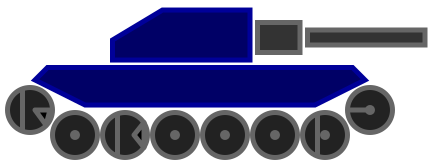
Bot Anatomy
Origins
Bot anatomy was documented by the RoboWiki community for classic Robocode and by the official Tank Royale documentation for Robocode Tank Royale.
Understanding how a bot is built is the first big step toward writing your own competitive bots. This page walks through how bots are represented on the battlefield and the main parts you can control: body, gun, radar, and energy.
In this book, the engine means the Robocode or Tank Royale game engine, the simulation that advances turns, moves bots and bullets, and delivers events to your bot.
Note
Applies to: Classic Robocode & Robocode Tank Royale
Focus: Conceptual understanding for new players with basic programming knowledge
1. Bot shape, size, and hitbox
On screen, you see a small tank-like bot, but the game engine actually cares about a simpler shape: its hitbox. This is what bullets and walls collide with.
Collision detection differences
- Classic Robocode
- Each bot is a 36×36 unit square on the battlefield.
- Uses axis-aligned collision detection: the square does not rotate when the bot turns. The sprite spins, but the underlying hitbox always stays axis-aligned (horizontal and vertical edges).
- This means a bullet can pass through the corner of the bot's visual representation even though it didn't hit the rotated square.
- Robocode Tank Royale
- Each bot is modeled as a circle with radius 18 units (effectively 36 units in diameter).
- Collision detection uses a bounding circle that is rotation-independent by design: turning the bot does not change the shape or collision behavior.
- This simplifies calculations: a hit is simply any bullet within 18 units of the bot's center, regardless of heading.
The bot center (its x/y position) and the hitbox around it are used for:
- Detecting bot vs wall collisions
- Detecting bot vs bot collisions
- Detecting bullet vs bot hits

Square hitbox used in classic Robocode (36×36 units, axis-aligned).

Circular hitbox used in Robocode Tank Royale (diameter 36 units).
Important for targeting
When calculating virtual bullet hits (for targeting), remember to use the correct hitbox shape and rules for your platform. Classic Robocode's axis-aligned square behaves differently from Tank Royale's circle, especially near bot corners and edges. See Tank Royale anatomy documentation for more details on Tank Royale collision detection.
2. Core parts of a bot
Every Robocode-style bot is made of three main moving parts plus an energy pool:
- Body: the chassis that moves around.
- Gun / turret: the rotating part that fires bullets.
- Radar: the rotating scanner that detects enemies.
- Energy: a number that acts as both health and ammunition.

Main parts of a bot: body, gun, radar, and energy pool.
Each moving part has their own headings (angles) and sometimes their own turn rate limits.
2.1 Body
The body is the main bot:
- It has a position (x, y) on the battlefield.
- It has a heading (direction it faces).
- It has a velocity / speed along its heading (positive forward, negative backward).
Movement commands in the API (such as “move ahead N units” or “set forward velocity”) affect the body. The body:
- Accelerates and decelerates within fixed limits per turn.
- Has a maximum speed it cannot exceed.
- Has a maximum turn angle per turn – it can only rotate so far each tick.
You cannot instantly jump from standing still to max speed, or from full speed forward to full speed backward. The engine applies realistic-ish constraints: each turn it adjusts your speed by at most the allowed acceleration or deceleration.
We’ll go deeper into numbers and formulas in Movement Constraints & Bot Physics later in the book. Here, just remember:
- Speed changes gradually (accel/decel limits).
- Direction changes gradually (max turn per turn).
2.2 Turret and gun
The gun is mounted on a turret that can rotate separately from the body. In most docs, “gun” refers to this entire rotating assembly.
Important points:
- The gun has its own heading.
- Bullets travel in the direction of the gun heading, not the body heading.
- The gun has a maximum turn angle per turn, usually faster than the body.
- The gun does not collide with anything; only the body and bullets do.
Because the gun can be rotated independently of the body, you can:
- Drive one way with the body.
- Aim somewhere else with the gun.
- Keep shooting at a target while dodging in another direction.

Body and gun can have different headings; bullets fire in the gun direction.
2.3 Radar
The radar is a separate rotating part used only for sensing:
- It has its own heading.
- It has its own maximum turn angle per turn, often the fastest of all parts.
- It does not collide with anything. It is purely virtual.
2.4 Energy
Energy is the bot’s life bar and ammo pool:
- You lose energy when:
- Bullets hit you.
- You collide with walls.
- You collide with other bots (depending on direction and speed).
- You fire bullets (energy cost per shot).
- You gain energy when your bullets hit an enemy.
3. Body, gun, and radar movement (chained vs independent)
The engine lets you control body, gun, and radar each turn. These parts are chained by default:
- Turning the body also turns the gun and radar.
- Turning the gun also turns the radar.
The Bot APIs then give you tools to make the gun and radar behave independently when you want more control.
3.1 What “independent” means
By default, rotations are chained:
- Turning the body also turns the gun and radar by the same angle.
- Turning the gun also turns the radar.
When parts are independent, those automatic rotations are turned off:
- Turning the body does not drag the gun or radar with it.
- Turning the gun does not drag the radar.
- The body, gun, and radar can all rotate at their own speeds and even in different directions in the same turn.

Chained movement: body, gun, and radar rotate together.

Independent movement: body, gun, and radar rotate separately.
3.2 Why independence matters
Independence is mainly a strategy tool:
- Radar: Spin it almost constantly so you don’t lose track of enemies, even while dodging.
- Gun: Keep it aimed at your current target, adjusting its heading based on the latest scan data.
- Body: Move in patterns that make you harder to hit without disturbing where the gun and radar are pointing.
4. Movement, acceleration, and turning limits
4.1 Linear movement: speed, acceleration, deceleration
Each turn, the engine updates your speed based on the movement commands and physical limits:
- There is a maximum speed per bot.
- There is a maximum acceleration per turn.
- There is a maximum deceleration per turn.
4.2 Turn rates: body, gun, radar
Each rotating part has its own maximum turn angle per turn:
- The body turns relatively slowly.
- The gun typically turns faster.
- The radar is often the fastest.
5. Summary and where to go next
On this page you learned:
- How bots are represented on the battlefield (square vs circular hitboxes).
- The roles of the body, gun, radar, and energy.
- How independent movement lets you rotate body, gun, and radar separately.
- The basic movement constraints: max speed, acceleration/deceleration limits, and separate turn limits for body, gun, and radar.
Next, continue with:
- The Bot API: how the engine delivers scan/collision/bullet events and how you send commands back.
- Blocking vs Non-Blocking Movement (Setters): why
forward()/ahead()behaves differently fromsetForward()/setAhead().
Further Reading
- Bot Anatomy - RoboWiki (classic Robocode)
- Bot Anatomy - Tank Royale documentation